A travel agency in Piedmont has had a conversational assistant on its website for a few months. It gets between four and eight conversations a day, about two hundred a month.
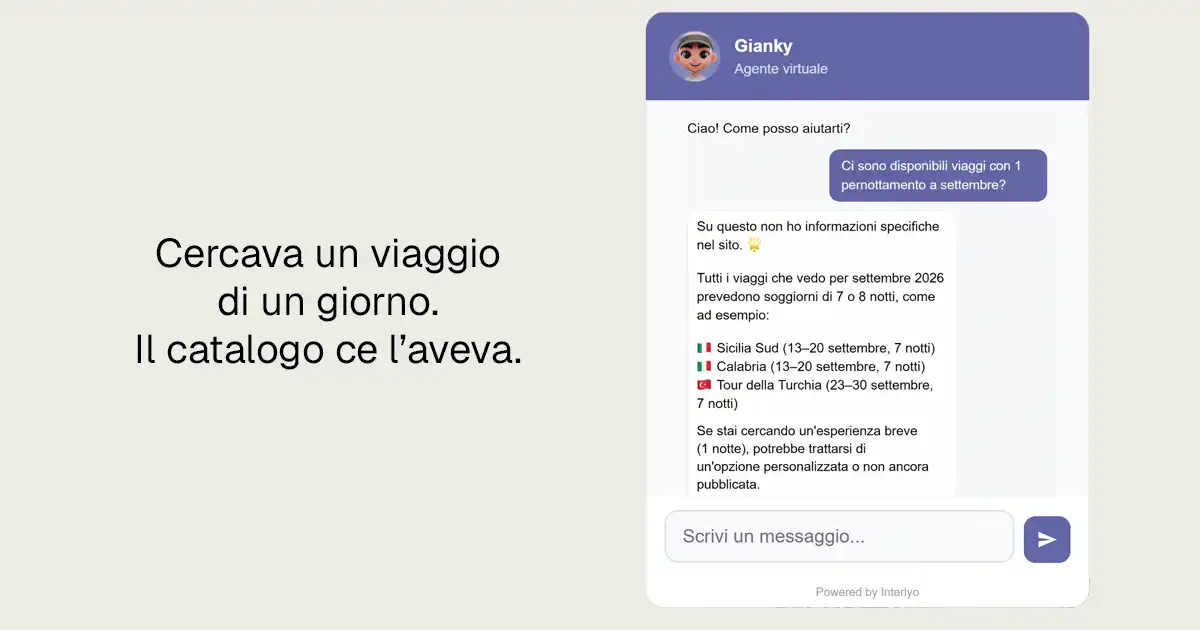
These are people writing in their own words, without going through a menu or a search form. Reading those conversations is probably the cheapest way I know to see where a website is badly organised. I’ll take just one, received this week.
The conversation
The conversation
The content was there. It was published, it was in the catalogue, it could be bought. It simply wasn’t found on the first attempt.
What that person was really looking for
Let’s reread the two questions and strip out the extra words. Two pieces of information are left: how long it lasts and when it leaves.
There’s no destination in the request. No country, no region, no place name: the person hadn’t decided where to go. They had decided how much time they had.
Anyone who works in a travel agency knows this: it happens all the time on the phone and at the counter. “I’ve only got the weekend”, “I’d like to get away for a week in August”, “something short, I haven’t got any leave”. The destination comes later, and choosing it is exactly where the travel consultant adds value.
On websites the opposite often happens. Almost all online catalogues are organised by destination, with at most a secondary filter by period. Length, when it’s there at all, appears as a detail inside the trip page: that is, only after the visitor has already chosen a destination which, in many cases, they didn’t have in mind yet.
The website asks visitors to answer first the question they can’t answer yet.
Why catalogues are built this way
Not through carelessness. A catalogue organised by destination reflects the way the people who build it think about it: by supplier, by geographical area, by sales season. It’s a useful structure for managing the product.
The visitor, though, isn’t buying an organised product: they’re buying three free days in September. The two structures don’t match and, on the website, the seller’s one often wins.
The second, less obvious detail
The first attempt didn’t fail because the trip was missing. It also failed because of language. “One overnight stay” and “one day” mean, to the person writing, basically the same thing: a short trip. In the catalogue those trips were described as “day excursions”, yet another different wording.
People searching use their own vocabulary, not the price list’s. There are plenty of variations for the same idea: day trip, one-day trip, day excursion, one night, short weekend, two days and one night, quick getaway. If your pages contain only one of them, all the other searches risk coming up empty, both on your site and on search engines.
Three things to do
- Add a filter by length. A few categories, not a drop-down menu with fifteen items: day trip, a weekend, a week, more than a week. Four simple ways to represent the time a person has available.
- Put the length in page titles. “Pietra Ligure, day trip, 7 September” tells you straight away what’s inside. “Pietra Ligure 2026” much less so.
- Use synonyms in your copy. Not to stuff pages with keywords, but because a page that contains both “day excursion” and “one-day trip” catches both searches. Sometimes one extra line in the description is enough.
None of the three changes requires rebuilding the website.
In short
That agency’s catalogue had the right answer from the start. It just couldn’t be reached with the words the person had used.
Before adding pages, content or advertising campaigns, it’s worth checking how many of the requests that come in already have an answer published on your site, but can’t reach it. That’s traffic you’ve already paid for, lost right at the last step.