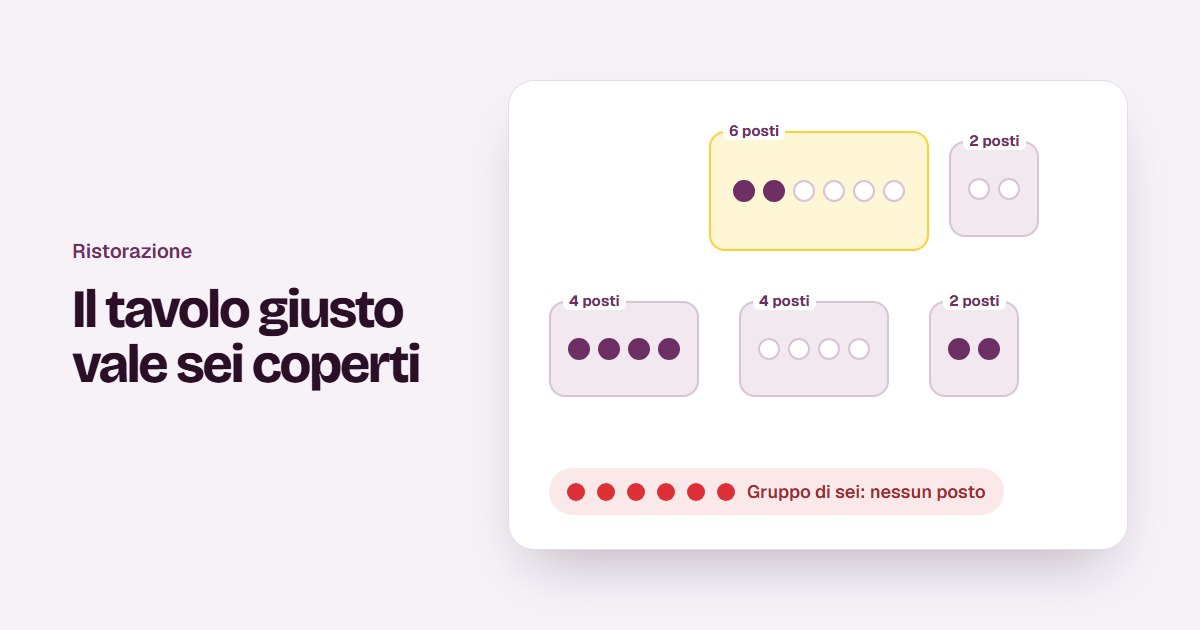
Saturday night. At five in the afternoon a couple books online and picks the table for six by the window: it’s free, it’s the nicest one, why not. At half past eight a family of six calls. The table for six has two people at it, the others are too small. The family goes elsewhere.
Nobody did anything wrong, and yet the dining room lost six covers. It’s one of the least visible costs of online bookings, and it almost always comes down to one thing: how the table is assigned.
The problem isn’t booking, it’s assigning
Many booking systems are built to solve the problem of the ringing phone. And they solve it: customers book by themselves, at any time. But they often treat the dining room as a list of identical places. They let the customer choose the table, or they assign the first free one.
Anyone who works front of house knows it doesn’t work like that. A table for six with two people at it is four covers that won’t come back that evening. An experienced manager knows this by instinct; an automated system has to know it by rule.
Rule 1: the smallest table that fits
The simplest rule is also the most effective: every booking gets the smallest table that holds the group. Two people at a table for two, four at a table for four. The large tables stay free for as long as possible, for the groups that really need them.
That’s why it’s better for the customer to choose the time, not the table. The window is lovely, but the person booking can’t see the whole room: the system can.
Rule 2: decide which tables can be joined
Two tables for two next to each other become a table for four. Two tables for two at opposite ends of the room don’t. It seems obvious, but a system that adds up free seats without knowing where the tables are will promise impossible combinations.
The fix is to say it once and for all: table 1 joins with 2, 3 with 4, the terrace tables with each other. From then on, if a group doesn’t fit at a single table, the system looks for a free pair among those that can be joined and books it as one table.
First the smallest single table that fits, then joining. Never the other way round.
Rule 3: every service has its own length
A quick lunch doesn’t take up the table as long as a tasting dinner. If every service has its own length, the system knows when the table becomes free again and can offer a second sitting without overlaps. If the length is always the same, or there isn’t one, you end up either blocking the table all evening or double-booking it.
Rule 4: only ask when there’s a choice
Inside or on the terrace? It’s a good question only if there’s room in both at that time. If only the terrace is free, asking is one more step that makes people abandon the booking. Ask questions when they’re needed, not out of habit.
A worked example
A small dining room: two tables for two, two tables for four and one table for six. On Saturday at 8pm, four requests come in, in this order: a couple, a group of four, another couple, a group of six.
- If the customer chooses the table. The first couple takes the table for six. The group of four takes a table for four, the second couple a table for two. Nothing is left for the group of six: one table for four and one for two, far apart. Seated: eight covers.
- With the smallest table that fits. The two couples go to the tables for two, the group of four to a table for four, the group of six to the table for six. There’s even a table for four left free for later arrivals. Seated: fourteen covers.
Same requests, same room, same evening: six covers’ difference. Over a year of Saturdays, those numbers show up in your accounts.
What to do starting tomorrow
- Draw your dining room. Every table with its real number of seats, not the theoretical one.
- Mark the possible combinations. Which tables really can be pushed together, without moving half the room.
- Give every service a length. Lunch, dinner, tasting menu, aperitivo.
- Keep everything in one place. Bookings taken by phone go into the same system as online ones, otherwise no rule can work.
In short
Online bookings shouldn’t just take work off the phone: they should fill the room better than you would by hand, not worse. A few clear rules, decided once, are all it takes: the smallest table that fits, the possible combinations, the length of each service.
The customer chooses when to come. The system takes care of the right table.